Who was the Pharaoh of the Exodus?
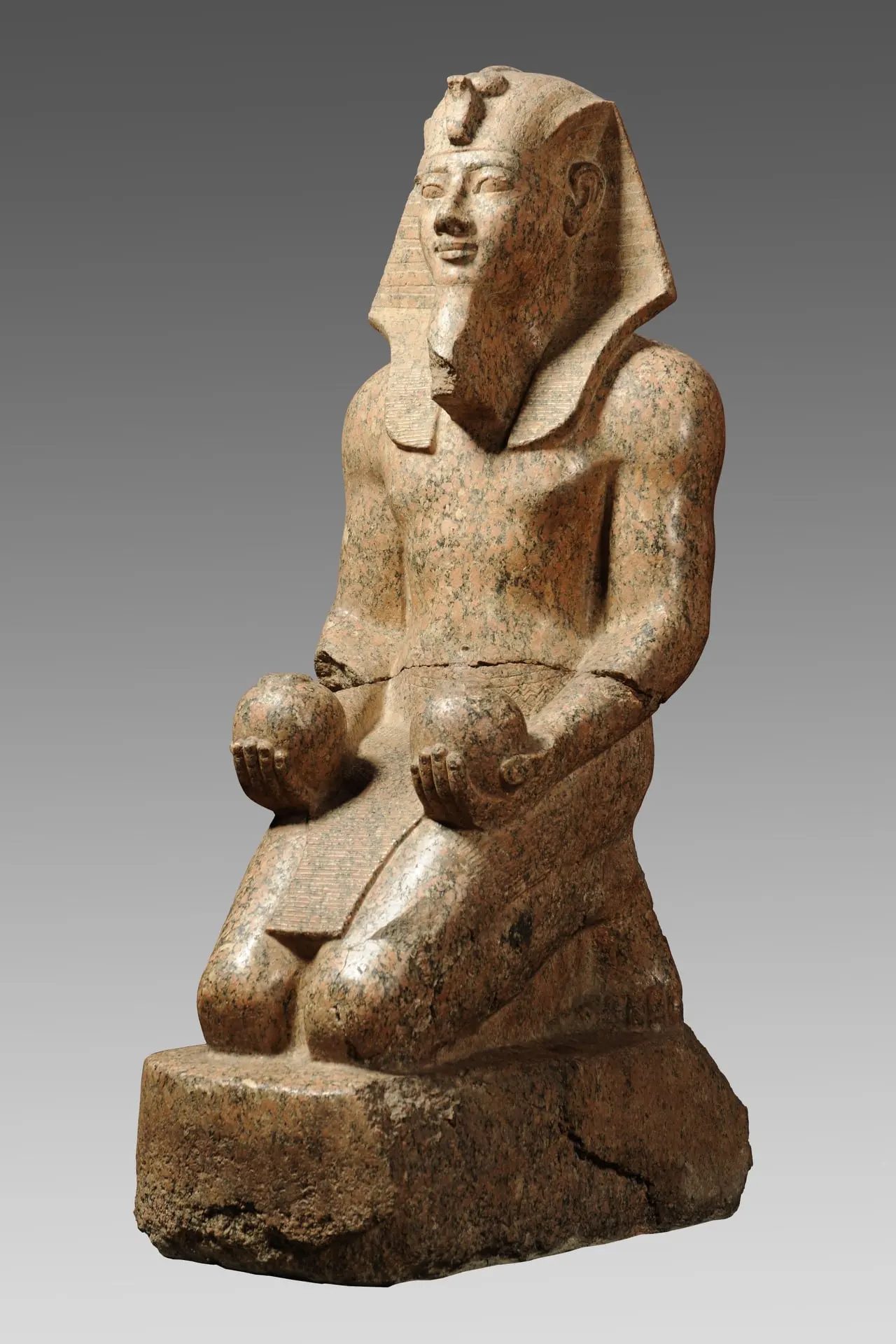
Question: Who was Pharaoh during the exodus?
Answer: Short answer: Amenhotep II
Long Answer: Pharaoh Thutmose III died around about 1425 BC, and Moses would be about 60 years of age at that point. Moses was outliving his Egyptian contemporaries and was still physically active.
Pharaoh Thutmose’s eldest son had died earlier so another son of his, called Amenhotep, took the throne. His name as pharaoh was Amenhotep II. This particular pharaoh not being a firstborn son is worthy of note because later in the story the firstborn Egyptian sons die but Pharaoh himself did not die as he was not a firstborn son.
Towards the end of chapter 2 in the book of Exodus the narrative speaks of the time Moses spent in Midian.
“During that long period, the king of Egypt died. The Israelites groaned in their slavery and cried out, and their cry for help because of their slavery went up to God” (Exod 2:23–24).
The Israelites had now been oppressed for some 125 years and the outlook was bleak: the new pharaoh, Amenhotep II, was not the type of man who would make life easier for them. We have access to the contents of a personal letter from Amenhotep II written by himself to his viceroy of Nubia, whose name was Usersatet. In the letter we see that Amenhotep II had a certain contempt for foreigners. The letter reads: “These people from Tekshi (Syria) are worthless—what are they good for?”
As well as his xenophobic advice, Amenhotep II also berates the viceroy for promoting a Nubian servant to a higher position: “Do not trust the Nubians, but beware of their people and their witchcraft. Take this servant of a commoner, for example, whom you made an official although he is not an official whom you should have suggested to His Majesty; or did you want to allude to the proverb: ‘If you lack a gold battle-axe inlaid with bronze, a heavy club of acacia wood will do’? So, do not listen to their words and do not heed their messages!”
Amenhotep II’s physical prowess has also been written about. Inscriptions claim he could shoot an arrow through a copper target one palm thick, and that he was able to row his ship faster and farther than two hundred members of the navy could row theirs. I guess it’s left to our own mind to decide whether these inscriptions are actually true.
The king’s athleticism also played a part in foreign affairs when he is said to have singlehandedly killed seven rebel princes at Kadesh, which successfully terminated his first Syrian campaign on a victorious note. After the campaign, the king ordered the bodies of the seven princes to be hung upside down on the prow of his ship.
These writings give us a small glimpse into the personality of Amenhotep II.
The 18th Dynasty began a fresh era in Egypt that Egyptologists call the New Kingdom. With Amenhotep II the dynasty would be on its 7th pharaoh. Amenhotep II was born and raised in Memphis, located in Lower Egypt (lower because of the landscape: the river Nile starts at a higher elevation in the south, known as Upper Egypt, and gradually works its way to a lower elevation in the north). The traditional capital of Egypt had been in Thebes, located in Upper Egypt, but since the Hyksos ruled from Lower Egypt, the 18th Dynasty decided to fortify the Nile delta area and have a royal presence there.
The Israelites were located to the east of the delta in Lower Egypt. Amenhotep II knew the area well and part of his duties as a prince was to oversee the deliveries of wood at the dockyard in Memphis.
He was also designated High Priest over Lower Egypt. Amenhotep II came to the throne early in life: he was 18 years of age when he took total control.
Moses had heard about God, probably from his real mother, Jochabed. Moses had also been under the influence of Reuel who was a priest of God. Furthermore, he would be well acquainted with the gods spoken of by the Egyptians, from which there were many to choose. At this point God had not yet introduced himself to Moses as the God of heaven and earth but simply as the God of Abraham, Isaac, and Jacob. Moses was on a learning curve himself.
Since his last attempt at being a hero ended in shambles, Moses had been humbled and was now quite content to spend his days with Jethro’s family around him in Midian, he didn’t want any excitement of this nature in his life. So Moses, at the burning bush, felt cornered by the God of Abraham, Isaac, and Jacob and needs to think on his feet and he reasons that God’s directive warrants a response, so he ventures a reply. “Who am I that I should go to Pharaoh?” (Exod 3:11).
Moses was right, who was he? He’d lost all privileges of being in the royal court, in fact he was a wanted man in Egypt, although the pharaoh who issued the judgement was now dead and a new pharaoh was in place.
Amenhotep II had been born about 5 years after Moses’s escape to Midian, so the pharaoh now in charge would not know Moses. Moses was living long, and his features would probably have changed a little with age. His appearance would also be different from being a clean-shaven regal Egyptian to a shepherd with the likeness of a shepherd.
Owing to his long life and image change, if there were some people in Egypt who may remember him from his days in the Egyptian royalty, he may still be able to move freely without revealing who he actually was. But Moses would hear the skeleton in his closet rattling quite loudly.
Another worrying feature for Moses of this request from God would be that Moses had heard about the new pharaoh’s character. The Encyclopaedia Britannica advises us that Amenhotep II’s warrior father carefully guided his upbringing, with great emphasis on physical strength, skills of warfare, and sportsmanship. Amenhotep II never tired of boasting of his feats in these skills. We’ve already heard of Amenhotep II’s disdain for foreigners, and Moses would have heard these things too.
God replies by telling Moses that he will be with him, and that once the Israelites are out of Egypt they will worship God on this mountain—Mount Horeb.